⚠️ Excerpt from Part 1 of my book. It’s about how interstate commerce and fake milk helped expand free speech in America. If that doesn’t arouse your curiosity, go watch Cornhub.
Preferred Freedoms Doctrine (or How a Free Speech Doctrine Magically Materializes From a Footnote to Boring Economic Stuff About “Filled Milk”)
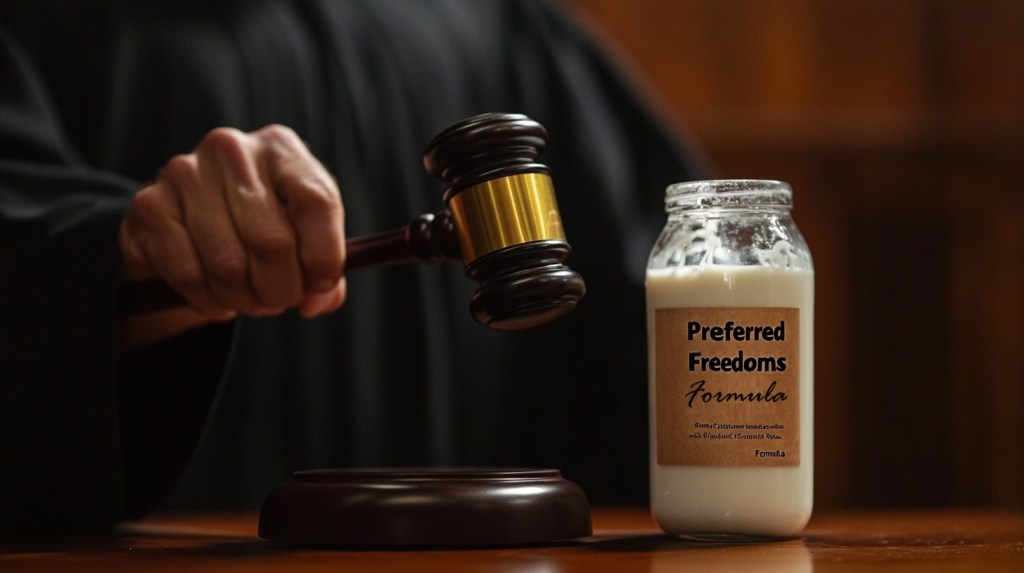
Yeah. That’s right. American free speech protections evolved partly from an argument about the legality of interstate commerce of something called “filled milk,” which I can only assume was Congress’s attempt to outlaw expired Yoo-Hoo in disguise. Essentially, Congress passed the Filled Milk Act of 1923, which banned the product from crossing state lines. And then a company called Carolene Products said “to hell with Congress” and proceeded to violate the Filled Milk Act. So this dairy hullabaloo reached the Supreme Court, whose justices were like, “The Filled Milk Act is fine but meh, economics isn’t any of my business anyway, so whatever… keep your stupid milk law and do whatever… oh, and by the way, here’s a totally irrelevant footnote that would change American legal history. lol.”
Anyway, brownie points to Justice Harlan F. Stone for managing to not only stay awake but surreptitiously inject the famous Fourth Footnote in his opinion in United States v. Carolene Products (1938), a case so dry you have to wonder why the milk didn’t fully evaporate:
There may be narrower scope for operation of the presumption of constitutionality when legislation appears on its face to be within a specific prohibition of the Constitution, such as those of the first ten Amendments, which are deemed equally specific when held to be embraced by the Fourteenth Amendment…
And here’s what my Bullshit Legal Translator (BLT) outputs:
Look, you Congressional dipshits. You can pass all sorts of dumbass laws. But if any of those laws smells like it’s crapping on the Bill of Rights, we’ll see if you have to eat it. And God help us if it’s an unconstitutional state law, because we’ll bludgeon you with the metaphorical incorporation club of the Fourteenth Amendment and make you eat what you just shat out.
And then Stone writes:
It is unnecessary to consider now whether legislation which restricts those political processes which can ordinarily be expected to bring about repeal of undesirable legislation, is to be subjected to more exacting judicial scrutiny under the general prohibitions of the Fourteenth Amendment than are most other types of legislation…”
Which my BLT succinctly puts as:
Don’t worry, Congress. We’re not force-feeding you jurisprudential excrement. Yet. But if you mess with any part of the democratic process, which even numbnuts like you know includes voting, political speech, and participation, we’re gonna serve you the figurative feces of constitutional wrath.
And the last part of Footnote Four:
Nor need we enquire whether similar considerations enter into the review of statutes directed at particular religious, or national, or racial minorities; whether prejudice against discrete and insular minorities may be a special condition, which tends seriously to curtail the operation of those political processes ordinarily to be relied upon to protect minorities, and which may call for a correspondingly more searching judicial inquiry.
Finally, we can use BLT to translate this legal bullshit as:
Neither are we saying that you’re currently mean to Hispanics, Asians, Blacks, Native Americans, Jews, Muslims, Zoroastrians, Baháʼís, marginalized folks, or immigrants, but rest assured we’ll ensure you drown in your own congressional shit if we one day decide that you fucked with these wonderful people you love to bully.
For a dry little footnote, this was monumental. Indeed, it was nuclear for American jurisprudence. You see, the Supreme Court used to treat all laws—speech, race, religion, economic regulations, whatever—as if they were all equally important and granted them VIP status under the name of “rational basis review,” which is legally equivalent to Oprah handing out rubber stamps that say, “You get a law! You get a law! Every stupid law gets upheld!”
Thus, due to the Court’s use of rational basis, Congress could have easily passed a law that banned people from wearing jorts while driving minivans just because those legislative wankers could have argued that that ungodly combo might somehow increase gang violence, and the Supreme Court would have said, “Well, that’s kind of dumb. But not unconstitutionally dumb. So say no to cringey soccer dads, Congress. Carry on.”
But after Carolene, the Supreme Court considered rational basis too lax when it came to Congress making laws that infringe on our fundamental rights in the democratic process—those are inalienable rights that we call “civil rights,” ladies and germs, and they must be given extra protection in this new legal doctrine called Preferred Freedoms. So, for a short time post-Carolene, whenever Congress passed laws that limited your freedom to express yourself with jorts and fashionably questionable automobiles, the Supreme Court would kick rational basis to the curb and use a legal microscope to evaluate the constitutionality of the law, which means that those dumb laws would usually lose. (Later, these more stringent tests would evolve into what are called “intermediate scrutiny” and “strict scrutiny” standards, but we’re not at that part of the book yet, so hold onto your lederhosens, please.)
Anyway, the Preferred Freedoms doctrine in Carolene is basically Justice Stone starring in the special SCOTUS version of Pulp Fiction while screaming, “Say ‘rational basis’ again! I dare you! I double dare you, motherfucker! Say ‘free speech and democracy are no more important than filled milk’ one more goddamn time!” before everyone shits themselves and Footnote Four kicks in the courthouse doors like Samuel L. Jackson in a powdered wig, quoting the First Amendment and holding Congress at metaphorical gunpoint while Brandeis lights a cigarette with the Filled Milk Act, because it’s not like anyone was gonna drink that crap anyway.
The point being? An inconspicuous footnote in the Court’s opinion of a boring case about the economics of fake milk not only established the Preferred Freedoms doctrine, foreshadowing the Court’s commitment to affording extra protection for fundamental rights (e.g., free speech) and for minority groups and unpopular voices, but revolutionized the Court’s primary role itself. The Preferred Freedoms doctrine shifted the Court’s priorities away from debates on private economic affairs and questions of government power, making the Court focus instead on what the People truly care about: civil rights and liberties.
Wait… did you think I was done discussing Preferred Freedoms? That I would end on a tone of reverence toward the Republic and strike such a patriotic chord with you that we all cry Bald Eagle tears? Nah. I didn’t even shit on this one yet. And where’s the fun in all of this if I don’t get to complain a little about a well-loved bit of legal trivia? Surprise, mofo! Here’s why the Preferred Freedoms doctrine sort of sucks:
- It is exactly what it sounds like—a doctrine. It is not a legal test, as Clear and Present Danger and Bad Tendency are. So while Preferred Freedom does sound awesome for anyone who likes to run their mouth, it is more of a murky promise to head in the right direction than it is a specific vehicle to get you where you want to be—so no real instructions, just vibes.
- It implies that some speech gets extra protection while others might not, and if the Court decides that YOUR speech is not worthy of extra legal protection, you’ll have to either swallow your righteous indignation or self-combust.
- It was literally written in a goddamn footnote about milk, which is about as official as if the pillars of democracy had been scribbled on an empty can of Mountain Dew.
So yeah. Lesson learned: Remember Clear and Present Danger and Bad Tendency and don’t take your freedom for granted, but also don’t ever be satisfied with the status quo, which, in a democracy like the United States, is just euphemism for “Hey, the government didn’t immediately imprison you for talking shit about it this time, so wouldn’t it be fun if the law tried to shaft you while you let your guard down?” I rest my case for now.
 Free Speech Troll
Comment, Peasant.